The Intelligence Explosion Has a Date
For decades, the “intelligence explosion” belonged to science fiction, philosophy departments, and late-night conversations in Silicon Valley.
That is no longer true.
The intelligence explosion is becoming an infrastructure question. It can increasingly be studied through capital expenditure, electrical capacity, accelerator shipments, algorithmic efficiency, and the length of tasks AI systems can complete without human intervention.
My base case is clear:
The intelligence explosion will most likely begin in 2029, with a plausible window from late 2028 to 2031.
I do not mean that a machine will suddenly wake up on January 1, 2029.
I mean that around 2029, AI systems are likely to become capable of completing enough long, economically valuable technical work—including parts of AI research itself—that improvements in intelligence begin materially accelerating further improvements in intelligence.
The process will probably unfold over 12 to 24 months. From the outside, it may initially look like faster software development, unusually productive research teams, falling inference costs, and another wave of data-center construction.
Only in retrospect will it look like an explosion.
What an Intelligence Explosion Actually Means
The term dates to mathematician I. J. Good’s 1965 paper, Speculations Concerning the First Ultraintelligent Machine.
Good’s core argument was that machine design is itself an intellectual activity. Once a sufficiently capable machine can help design better machines, a positive feedback loop becomes possible.
That definition is more useful than debating whether a model has reached artificial general intelligence.
An intelligence explosion begins when four conditions exist at the same time:
- AI can perform substantial portions of AI research and engineering.
- AI-generated improvements can be tested quickly and objectively.
- Better systems can be copied and deployed at large scale.
- The economic returns fund even more compute, energy, data, and research.
The result does not need to be infinite or instantaneous.
A feedback loop that reduces a six-month research cycle to three months, then six weeks, and then two weeks would already qualify as an intelligence explosion in practical economic terms.
The central question is therefore not:
When will AI become conscious?
It is:
When will AI become good enough at producing AI progress that the development cycle begins compressing itself?
The Physical Buildout Is Already Happening
The strongest evidence for a coming intelligence explosion is not a chatbot demonstration.
It is the amount of physical infrastructure being built.
Amazon, Alphabet, Microsoft, and Meta have announced capital-expenditure programs measured in the hundreds of billions of dollars. Although the companies categorize their spending differently, much of the growth is being driven by servers, accelerators, networking infrastructure, and data-center construction.
Not every dollar is being spent directly on AI. Amazon still operates a massive logistics network, while companies use different accounting treatments for equipment and leases.
Even with those caveats, the scale is extraordinary.
This is no longer a venture-capital experiment. It is an industrial mobilization.
Microsoft has described plans to rapidly increase its available data-center capacity. Alphabet has said that the majority of its technical infrastructure investment is being directed toward servers, networking equipment, and data centers. Meta is building larger clusters to support increasingly compute-intensive models.
Capital markets often treat these numbers as forecasts about cloud demand.
They are also forecasts about machine capability.
The companies with the best access to internal model-performance curves are committing enormous amounts of money before the resulting capacity is fully operational.
They may be wrong about the return on that investment. They are clearly not behaving as though AI progress is about to plateau.
Power Is Becoming the Binding Constraint
Global data-center electricity demand is moving onto a different growth curve from the rest of the economy.
The International Energy Agency projects that global data-center electricity consumption could roughly double by 2030, reaching approximately 945 terawatt-hours per year.
That would make data centers a meaningful component of global electricity demand rather than a niche category inside the technology industry.
The numbers are particularly significant in the United States.
Lawrence Berkeley National Laboratory estimates that data centers could account for a substantial share of US electricity consumption by 2030. Under higher-growth scenarios, data centers could consume more than 15% of the country’s electricity.
Data centers are not merely taking a larger share of corporate technology budgets.
They are becoming a material category within national energy systems.
That has several consequences.
First, AI progress will be geographically uneven. Regions with available generation, transmission, land, cooling, and permitting will obtain an advantage that cannot be replicated through software alone.
Second, the AI supply chain is expanding beyond semiconductor companies. Transformers, turbines, switchgear, cooling systems, fiber, grid interconnections, construction labor, and power contracts are becoming part of the intelligence supply chain.
Third, electricity will increasingly determine where intelligence is produced.
The US Department of Energy has discussed connection requests for hyperscale facilities requiring hundreds of megawatts—and, in some cases, close to a gigawatt of power.
Grid connection and construction projects of that size can require several years.
The gigawatt-scale projects being financed and permitted now are therefore not primarily a 2026 story. Much of their effect will arrive between 2028 and 2030.
That is the first reason I place the explosion near 2029.
Compute Is Still Scaling Faster Than Normal Intuition Can Handle
The amount of computation used to train frontier language models has increased dramatically over the past several years.
Epoch AI estimates that the compute used for leading language-model training runs has grown by several times per year since 2020.
Stanford’s AI Index also documents rapid expansion in global AI compute capacity, driven by the deployment of millions of increasingly powerful accelerators.
No exponential trend continues forever.
Power, financing, semiconductor fabrication, data availability, and engineering complexity will eventually slow raw scaling.
But raw compute is not the only variable that matters.
AI capability is being advanced by several forces at once:
- More chips
- Better chips
- Larger training runs
- More inference-time reasoning
- Better data curation
- Synthetic training data
- Improved post-training
- Better agent frameworks
- More efficient algorithms
The cost of reaching a fixed level of model performance can fall even while spending at the frontier rises.
Stanford’s AI Index found that the cost of querying a model performing near GPT-3.5’s level on a widely used benchmark fell by more than 99% between late 2022 and late 2024.
This combination is economically powerful.
The frontier becomes more expensive, but yesterday’s frontier becomes dramatically cheaper. That allows intelligence to spread through the economy while the largest laboratories continue pushing into more costly territory.
The Most Important Capability Chart Is Not a Chatbot Leaderboard
Static benchmarks are becoming less useful.
Models are often trained against them, and benchmark performance does not tell us whether an AI system can independently complete a real project.
A more revealing metric is the task-completion time horizon.
The nonprofit research organization METR defines this as the amount of time a skilled human would need to complete tasks that an AI agent can successfully complete at a given reliability level.
For example, a 50% time horizon of two hours means the system can successfully complete, about half the time, tasks that would take a qualified human approximately two hours.
METR’s research found that the task horizon of frontier AI systems doubled approximately every seven months between 2019 and the middle of the 2020s.
The researchers cautioned that their tasks were concentrated in areas such as software engineering, machine learning, and cybersecurity. The results should not be directly extrapolated to every job in the economy.
Even with that limitation, the trend is important.
Software engineering and machine-learning research are exactly the fields in which AI could begin improving AI.
Moving from a roughly day-scale task horizon to a month-scale task horizon requires approximately five doublings.
At a seven-month doubling rate, that takes close to three years.
More recent measurements suggest that progress may occasionally be faster. However, physical deployment, organizational integration, reliability problems, and the difference between benchmarks and real work make an immediate forecast too aggressive.
A base case around 2029 allows for capability growth to slow while still broadly following the longer historical trend.
Why Month-Scale Autonomy Changes Everything
An AI system that completes a two-hour coding task is useful.
An AI system that completes a month-long technical project is a new form of economic actor.
Month-scale autonomy does not mean the system must operate continuously for one month.
It means the system can successfully produce work equivalent to what a skilled person might need a month to complete.
That difference is crucial.
Most valuable work is not a single answer. It involves planning, recovering from errors, managing files, running experiments, interpreting results, changing direction, coordinating tools, and recognizing when an approach has failed.
Once AI systems become reliable over longer time horizons, companies can assign them outcomes rather than individual prompts.
Instead of asking an AI to write a function, a team could ask it to:
- Improve an inference kernel
- Reproduce and extend a research paper
- Optimize a distributed training pipeline
- Identify the cause of a recurring production failure
- Design and evaluate a new model architecture
- Reduce the cost of serving a model
- Run hundreds of experiments and summarize the results
This transition is especially important because software and AI research have unusually fast feedback loops.
An AI-generated drug still requires laboratory work and clinical trials. An AI-generated aircraft still needs to be manufactured and physically tested.
An AI-generated software optimization can sometimes be evaluated within minutes.
That makes software, algorithms, and AI research the most likely starting points for an intelligence explosion.
The Feedback Loop Has Already Begun
There is a tendency to imagine recursive self-improvement as an AI system directly rewriting all of its own source code.
The real process will probably be less cinematic and more distributed.
AI systems will help humans improve the many components involved in producing intelligence:
- Datasets
- Training code
- Evaluation systems
- Inference kernels
- Chip layouts
- Networking strategies
- Cooling efficiency
- Experiment selection
- Model architectures
We already have early examples.
Google DeepMind’s AlphaChip has been used to assist with layouts for several generations of Google’s tensor processing units. DeepMind says the system can produce strong chip layouts in hours rather than the weeks or months required by traditional workflows.
AlphaEvolve has been used to discover and optimize algorithms related to computing infrastructure, chip design, and AI training.
On RE-Bench, a benchmark focused on machine-learning research engineering, strong AI agents have outperformed human experts on some tasks when both were given short time budgets.
Humans still performed better over longer time horizons, demonstrating that current systems remain less reliable during extended projects.
This is not yet a runaway intelligence explosion.
It is, however, the beginning of the required feedback loop:
Better AI helps produce better algorithms and hardware, which lowers the cost of producing better AI.
The loop is currently weak, fragmented, and heavily supervised by humans.
The 2029 thesis is that it becomes strong enough to affect the overall rate of progress.
My Timeline Estimate
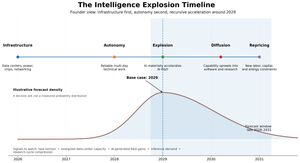
2026–2027: The Infrastructure Phase
The defining story is construction.
Hyperscalers secure chips, land, energy, networking equipment, and financing. Model providers improve agent reliability and integrate AI into software-development workflows.
Capabilities continue advancing, but real-world deployment remains uneven.
Many organizations discover that installing an AI tool is easier than redesigning a workflow around it.
This period will produce both spectacular demonstrations and disappointing productivity studies.
Some research has found that experienced developers can initially become slower when using AI tools, particularly when the tools produce subtle errors or require extensive review.
The lesson is not that AI is useless.
It is that model capability, usability, trust, context, and organizational productivity are different variables.
2028: The Autonomy Phase
AI agents become dependable on multi-day technical assignments in controlled environments.
Companies begin operating fleets of agents rather than distributing individual copilots.
The unit of AI consumption starts shifting from tokens and software seats toward completed work.
The first serious signs of research acceleration appear inside frontier laboratories, semiconductor companies, quantitative funds, and software-intensive businesses.
Data centers commissioned during the 2025–2027 investment cycle begin contributing substantial new capacity.
2029: The Intelligence-Explosion Phase
This is my base case for the transition.
The strongest AI systems become capable of completing a meaningful fraction of week- and month-scale software, machine-learning, and research-engineering projects with limited supervision.
AI laboratories begin using these systems throughout the research and development process:
- Generating hypotheses
- Designing experiments
- Writing code
- Analyzing failures
- Optimizing training
- Constructing evaluations
- Improving inference systems
The result is not an infinitely self-improving machine.
It is a measurable compression of the research cycle.
A laboratory that previously completed 100 meaningful experiments per month may be able to complete 1,000.
Improvements that once took an entire generation of models could begin arriving during a single generation.
Public model releases may become less important because continuously updated internal systems advance faster than normal product cycles.
The explosion becomes economically visible first in industries where output can be verified digitally.
2030–2031: The Diffusion Phase
The consequences begin moving outside the AI industry.
The price of useful cognitive work falls. Software production expands. Research-intensive companies reorganize.
Some workers become significantly more productive. Some forms of labor become less valuable. New bottlenecks emerge in management, energy, regulation, trust, distribution, and physical execution.
At this point, debates over whether the intelligence explosion has “really” happened may resemble debates over whether the internet was economically important in the late 1990s.
The answer will depend on which part of the economy you are looking at.
Three Possible Scenarios
| Scenario | Timing | What must be true |
|---|---|---|
| Early explosion | 2028 | Agent time horizons continue improving near their fastest recent rate, inference-time scaling remains effective, and gigawatt-scale capacity arrives without major delays. |
| Base case | 2029 | Long-horizon capabilities continue improving at a slower but sustained rate, data-center construction proceeds broadly as planned, and AI begins automating material parts of AI research and development. |
| Delayed explosion | 2031 or later | Reliability improvements slow, power and chip constraints become binding, frontier economics deteriorate, or regulation and organizational friction delay deployment. |
The important point is not that 2029 is certain.
It is that a clear, falsifiable base case is more useful than saying transformative AI is vaguely “five to ten years away” forever.
What Investors Should Watch
For investors, the intelligence explosion will not arrive as a press release.
It will appear first as a change in several measurable indicators.
Task Horizon, Not Benchmark Scores
The key question is whether AI systems can complete longer projects at high reliability.
Investors should watch evaluations that measure software engineering, machine-learning research, computer use, cybersecurity, and scientific workflows over hours or days.
A model that gains five points on a static test is interesting.
A model that moves from a four-hour reliable task horizon to a four-day horizon is economically significant.
Research Productivity Inside AI Laboratories
Model companies disclose little about their internal research productivity.
That makes indirect evidence valuable:
- Shorter intervals between major capability advances
- Faster reductions in training and inference costs
- More experiments per unit of researcher time
- AI-generated improvements to kernels, pipelines, architectures, and chip design
- Rising revenue without proportional growth in technical headcount
The strongest evidence for an intelligence explosion will be AI companies improving AI faster without adding equivalent numbers of human researchers.
Power Delivered, Not Projects Announced
Announcements are cheap. Energized capacity is not.
Investors should watch:
- Utility interconnections
- Substation construction
- Transformer deliveries
- Contracted generation
- Backup power
- Data-center completion
- Conversion of shell capacity into active computing load
The difference between a proposed data center and an operating AI cluster can be several years.
Utilization and Revenue per Unit of Compute
The bearish case is not necessarily that companies fail to build the infrastructure.
It is that they build it and cannot monetize it.
Utilization, cloud backlog, AI revenue, gross margins, depreciation, lease commitments, and free cash flow will show whether demand is keeping pace with construction.
A genuine capability explosion should eventually create demand faster than efficiency improvements reduce unit costs.
The Split Between Training and Inference
An intelligence explosion is likely to increase both training and inference demand.
Training demand rises because laboratories run more experiments and build more capable systems.
Inference demand rises because agentic systems consume far more computation while performing extended work.
If inference becomes the dominant workload, the industry may shift from a small number of enormous training events toward continuous, distributed machine labor.
Evidence of Recursive Improvement
The most important signal is not merely that AI can write code.
It is that AI-generated work improves the systems used to produce subsequent generations of AI.
That includes verified progress in:
- Training efficiency
- Inference efficiency
- Data generation and filtering
- Evaluation design
- Chip placement and architecture
- Distributed-systems optimization
- Automated machine-learning research
Once these improvements become routine rather than exceptional, the feedback loop is active.
What Could Make This Thesis Wrong?
The strongest argument against the 2029 thesis is that extrapolation is dangerous.
AI progress may encounter hard limits that recent trends do not reveal.
Long-context models can still lose track of their goals. Agents make strange mistakes, repeat failed actions, misunderstand ambiguous objectives, and struggle with organizational context.
METR itself warns that its evaluations use self-contained technical tasks and may not generalize cleanly to real jobs.
Scaling laws describe empirical relationships inside observed ranges. They are not laws of physics.
Additional compute might generate smaller economic improvements while the cost of obtaining each improvement continues rising.
Power could also become a serious bottleneck. Some estimates suggest that the largest frontier training runs could eventually require several gigawatts of electricity.
That is comparable to the output of multiple large power stations.
Capital markets could impose discipline before the technology reaches the required capability level.
Rising depreciation and financing costs may matter more than model improvements if revenue fails to keep up.
Regulation, export controls, community opposition, cybersecurity incidents, or geopolitical conflict could also delay construction and restrict deployment.
These are real uncertainties.
They are why I prefer a forecast window rather than a single prophetic date.
But none of them changes the central observation: compute, capital, energy, algorithms, and autonomous task performance are all moving toward the same threshold.
The Intelligence Explosion May Feel Slow Until It Feels Sudden
Large transformations are often underestimated because their physical foundations take years to build.
Railways required tracks.
Electrification required generation and transmission.
The internet required fiber, data centers, devices, and standards.
AI requires semiconductor factories, accelerators, substations, power plants, cooling systems, networks, data centers, and an enormous body of software.
During the construction phase, progress can look wasteful.
Capital expenditure rises faster than revenue. Depreciation increases. Projects are delayed. Utilization is uneven. Critics correctly identify overinvestment and hype.
Then the infrastructure becomes available at the same time that the applications become capable enough to use it.
That is when adoption can become nonlinear.
The intelligence explosion will probably not begin with a single supercomputer recursively rewriting itself in a locked laboratory.
It will begin when millions of AI agents, running across gigawatts of infrastructure, become capable of performing long technical projects—and when a portion of that work is directed toward making the next generation of agents better.
The data centers are being financed now.
The power is being contracted now.
The task horizons are lengthening now.
The feedback loop has already started, but humans still close most of it.
My base case is that this changes in 2029.
That date should not be treated as prophecy.
It should be treated as an underwriting assumption—one that can be updated as new evidence arrives.
The investors, founders, and policymakers who understand the transition earliest will not be those who predict the exact morning when machines become more intelligent than humans.
They will be those who recognize when intelligence begins producing more intelligence and understand that the economics of everything downstream are about to change.
Sources and Further Reading
- I. J. Good, Speculations Concerning the First Ultraintelligent Machine
- International Energy Agency, Energy and AI
- Lawrence Berkeley National Laboratory, United States Data Center Energy Usage Report
- Stanford Institute for Human-Centered AI, AI Index Report
- METR, Measuring AI Ability to Complete Long Tasks
- Epoch AI, Trends in Artificial Intelligence
- Epoch AI, How Much Power Will Frontier AI Training Demand in 2030?
- Google DeepMind, AlphaChip
- Google DeepMind, AlphaEvolve
- Amazon investor disclosures
- Alphabet investor disclosures
- Meta investor disclosures
- Microsoft investor disclosures
This article presents a technology forecast, not investment advice. Forecasts about frontier AI carry substantial technical, economic, and political uncertainty.